Exploring the various heights and configurations of WaveLight® Casonara Towers is no longer a purely technical exercise; it is a strategic decision about how your brand occupies vertical space in UK venues. As exhibition halls become denser and visitor journeys more fragmented, tower architecture now underpins visibility, wayfinding, and brand recall. Forward-thinking marketers increasingly treat towers as data-informed beacons rather than decorative extras, aligning height and configuration to traffic flows, ceiling restrictions, and future reuse across multiple shows.
In competitive UK venues, vertical design is becoming as critical as floorplan design for delivering stand-out exhibition performance.
Why tower height has become a strategic choice
In large UK halls such as ExCeL London, the NEC, or Manchester Central, tower height now functions as a navigation tool as much as a branding asset. The 2.4 m band typically clears shell scheme walls, improving line-of-sight from nearby aisles, while 3 m towers perform as hall-level markers in island and peninsula stands. Rather than simply “going tall”, the most effective exhibitors model key viewpoints and choose heights that punctuate these sightlines with clear, legible branding.
Key height options for WaveLight® Casonara Towers
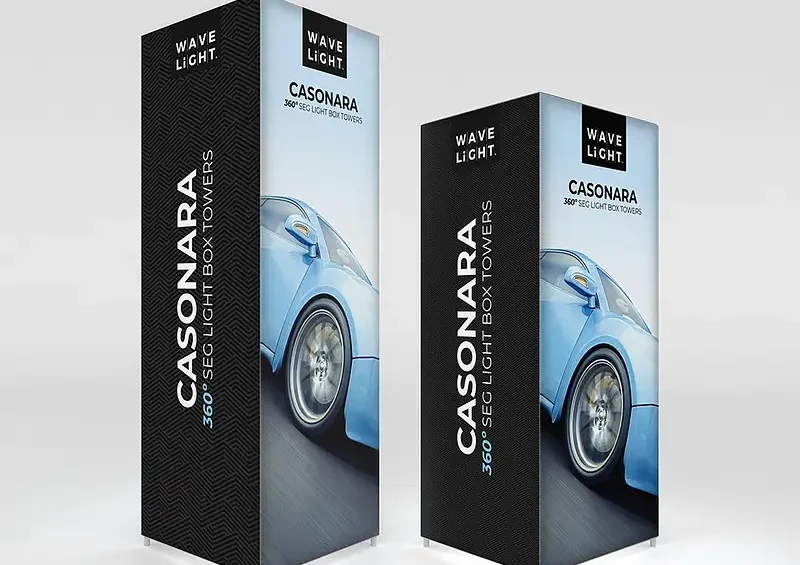
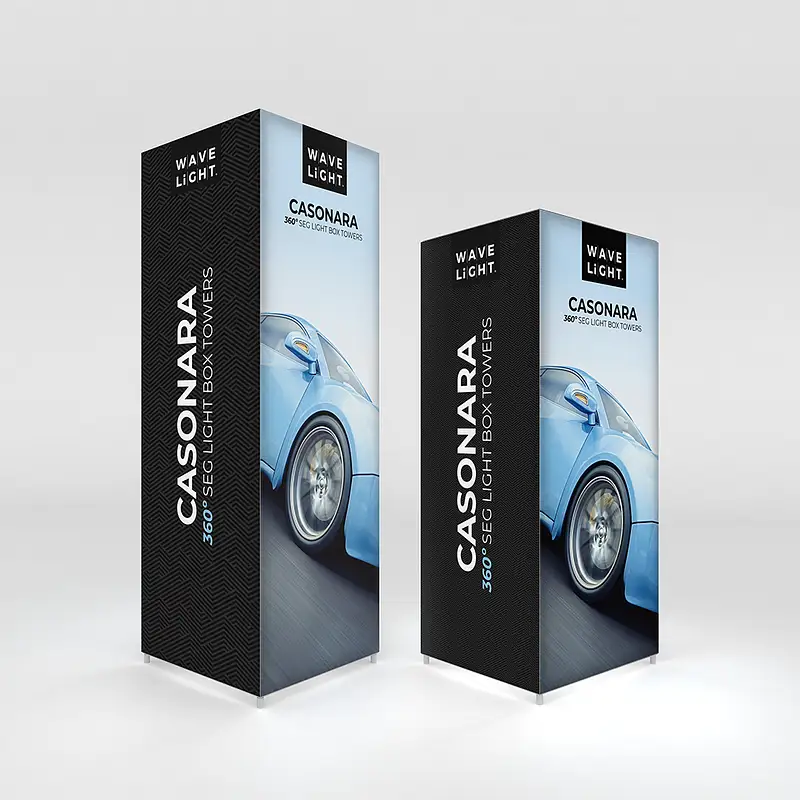
Standardised height bands around 2.4 m and 3 m allow teams to navigate UK venue regulations with confidence while still achieving strong visual impact. A 2.4 m solution can integrate seamlessly into compact custom exhibition stands without overwhelming them, particularly in 3 m x 3 m footprints. The 3 m option, by contrast, is best treated as a district-level marker, signalling zone entries, hero products, or lounges. When specified early, tower height can inform the entire stand composition, not just its finishing touch.
Configurations, footprints, and sightline engineering
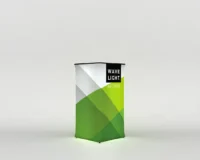
The most common footprint, a 1 m x 1 m square with heights around 2438 mm and 2950 mm, offers a stable, freestanding solution with 360° illumination that supports portable display towers without compromising structural integrity. Slimmer 350 mm profiles act more like illuminated exhibition towers or wayfinding fins, ideal for corners and constricted plots. By staggering multiple units in mixed heights, designers can choreograph vertical rhythm, subtly guiding visitors from outer approaches towards product clusters, demo zones, or meeting areas.
Because these structures function as modular LED tower displays, the graphics strategy must respect viewing distances and dwell behaviours. The lower third is best reserved for detail: QR codes, proof points, or supporting copy that benefits from close inspection. The mid-zone should carry concise messaging and LED backlit signage treatments optimised for cross-aisle reading. Upper sections must remain bold and simple—logos, symbols, or colour blocking that still read clearly from 20–30 metres, even in visually noisy environments.
Design, content, and lighting implications
Internal LED arrays turn SEG fabric lightbox towers into continuous, evenly lit canvases, but that does not guarantee effectiveness. Light spill, contrast, and colour temperature should be tuned to ensure faces and product displays remain comfortable to view. For brands aiming to position stands as premium trade show landmarks, towers should echo the wider lighting hierarchy, tying into counters, arches, and back walls. Done well, the stand becomes a coherent illuminated ecosystem rather than a cluster of independent glowing objects.
From a sustainability and ROI perspective, specifying reusable branded display columns with interchangeable graphics is now standard best practice. Savvy teams select UK WaveLight tower solutions that can transition from exhibitions into retail or corporate environments as backlit retail feature towers or energy-efficient event signage. Over a 12–18 month calendar, this unlocks significant savings compared with venue-specific builds, while maintaining a recognisable visual signature across different audiences and sectors.
Ultimately, WaveLight® Casonara Towers reward exhibitors who treat height and configuration as strategic tools, not afterthoughts. By aligning tower choices with audience journeys, venue constraints, and multi-show reuse plans, marketers can convert vertical volume into measurable gains in dwell time and recall. To stress-test your current approach, review your upcoming events, map key sightlines, and identify where refined heights, footprints, and illumination could unlock disproportionate impact. Then, speak with an exhibition specialist to translate those insights into a future-ready tower strategy.