How Hanging Banners Are Constructed: Materials, Hardware and Assembly Steps
Hanging banners are a versatile category of exhibition products designed to raise brand visibility above crowds and draw attention from across large spaces. In this overview, you will learn how the category combines materials, hardware, and simple assembly to deliver reliable overhead signage. Furthermore, you will see practical uses and advantages that help you choose the right combination for your events.
General information about hanging banner products
Hanging banners include a range of sizes, shapes, and support options, and they are suitable for trade shows, retail spaces, festivals, and corporate events. As a result, the category serves exhibitors who prioritize high-impact visuals with minimal footprint on the show floor. In addition, manufacturers offer modular options so that a single banner system can be redeployed in different venues, thereby maximizing your investment.
Frame and hardware: structural components and portability
Frames and hardware form the backbone of hanging banner systems. Typically, lightweight aluminum poles or reinforced composite frames provide the structural integrity needed for overhead displays, and quality hardware such as clamps, rotatable brackets, and safety cables secure the banner to a venue rigging point.
Consequently, you benefit from a blend of strength and portability. Because frames are engineered to be both sturdy and lightweight, transport and setup become easier. Moreover, reliable hardware reduces setup time and increases safety, giving you confidence that your display will remain secure throughout an event.
Fabrics and graphics: material quality and visual impact
Fabric selection and print technology determine the visual performance of hanging banners. Typically, tension fabric, polyester blends, and coated textiles are used because they deliver vivid colour reproduction, resistance to fading, and wrinkle recovery. In addition, dye-sublimation and UV-cured printing methods ensure long-lasting graphics that hold up under frequent use.
Therefore, when you select a hanging banner, consider both the fabric weight and the printing process. Heavier fabrics add durability, while advanced printing preserves brand colours. As a result, your overhead signage continues to represent your brand professionally over many events.
Assembly and setup process: fast and reliable installation
Hanging banners are designed for straightforward assembly, and many systems use snap-fit frames, elastic corner pockets, or Velcro-secured hems for quick installation. Consequently, event crews can assemble or replace graphics in minutes, which reduces labor costs and downtime at exhibitions.
In addition, clear assembly instructions and modular components allow you to scale a display from single banners to multi-panel arrays. Therefore, setup remains predictable and repeatable, and you can focus on attendee engagement instead of troubleshooting hardware.
Integrated systems and long-term durability
Integrated construction combines frame design, fabric engineering, hardware quality, and print technology into cohesive systems that perform consistently. Consequently, when components are engineered to work together, you get predictable tension, reliable attachment points, and graphics that stay taut and readable.
Moreover, high-quality systems extend the useful life of your hanging banners. As a result, cost per use falls and the total return on investment improves. Therefore, choosing integrated solutions helps you maintain professional presentation across seasons.
Use cases and creative configurations
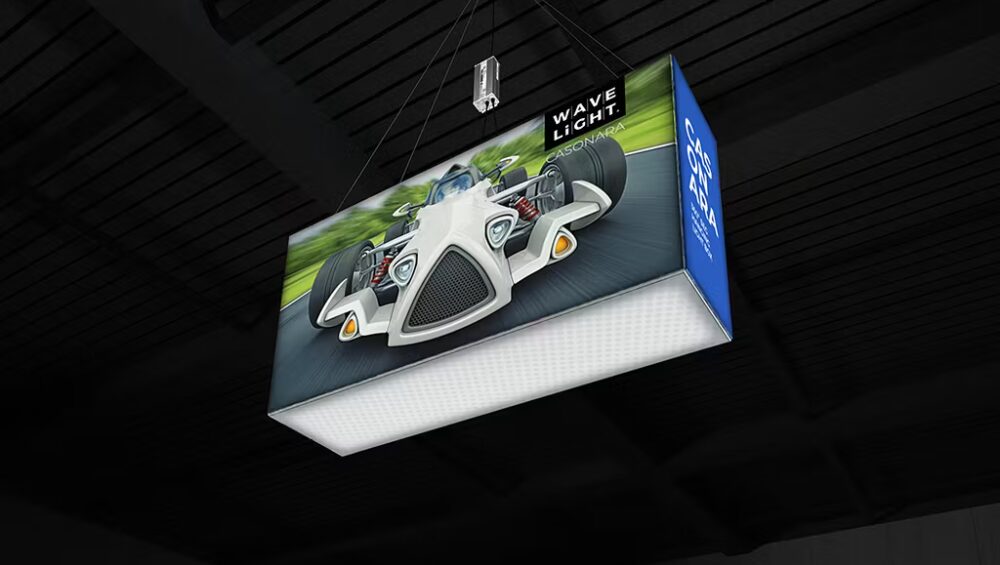
Hanging banners can be used alone for a strong focal point, or combined with other exhibit elements for layered visual effects. For example, several circular banners at different heights create depth above an island booth, and rectangular banners can be paired with backwalls to guide visitor flow. Additionally, you can use double-sided graphics for 360-degree visibility, and modular panels to adapt messaging between events.
Consequently, creative combinations let you tailor the impact to the venue and audience. Furthermore, portability means you can reuse the same components in retail pop-ups, conferences, and sponsorship activations, which increases versatility and reduces procurement time.
Conclusion: category advantages and next steps
In summary, the hanging banner category delivers high-visibility solutions that balance visual impact, durability, and ease of use. Because the systems combine engineered frames, quality fabrics, dependable hardware, and advanced printing, you receive a versatile toolkit for exhibition and promotional needs. Ultimately, these products help you stand out in crowded environments while minimizing setup complexity and long-term costs.
Discover how hanging banners are constructed and how this system can maximize your exhibition investment.